
The Imposters: Team Building for Trust, Communication and Decision-Making Under Pressure
Organisations are operating in an environment where uncertainty is no longer occasional. It is constant.
Political change, economic pressure, social disruption, technological acceleration and shifting workplace expectations are all placing new demands on teams. People are expected to adapt quickly, process information faster and make decisions when the full picture is not always clear.
In this context, team performance depends on more than activity. It depends on trust, communication, judgement and the ability to work together when circumstances are ambiguous.
That is where purposeful team building has an important role to play.
At BlueSky Experiences, we believe team building should do more than entertain. It should bring people together in a way that strengthens how they communicate, collaborate and perform back in the workplace. The experience should be enjoyable, memorable and energising, but it should also reveal something useful about how the team operates.
The Imposters has been designed with exactly that in mind.
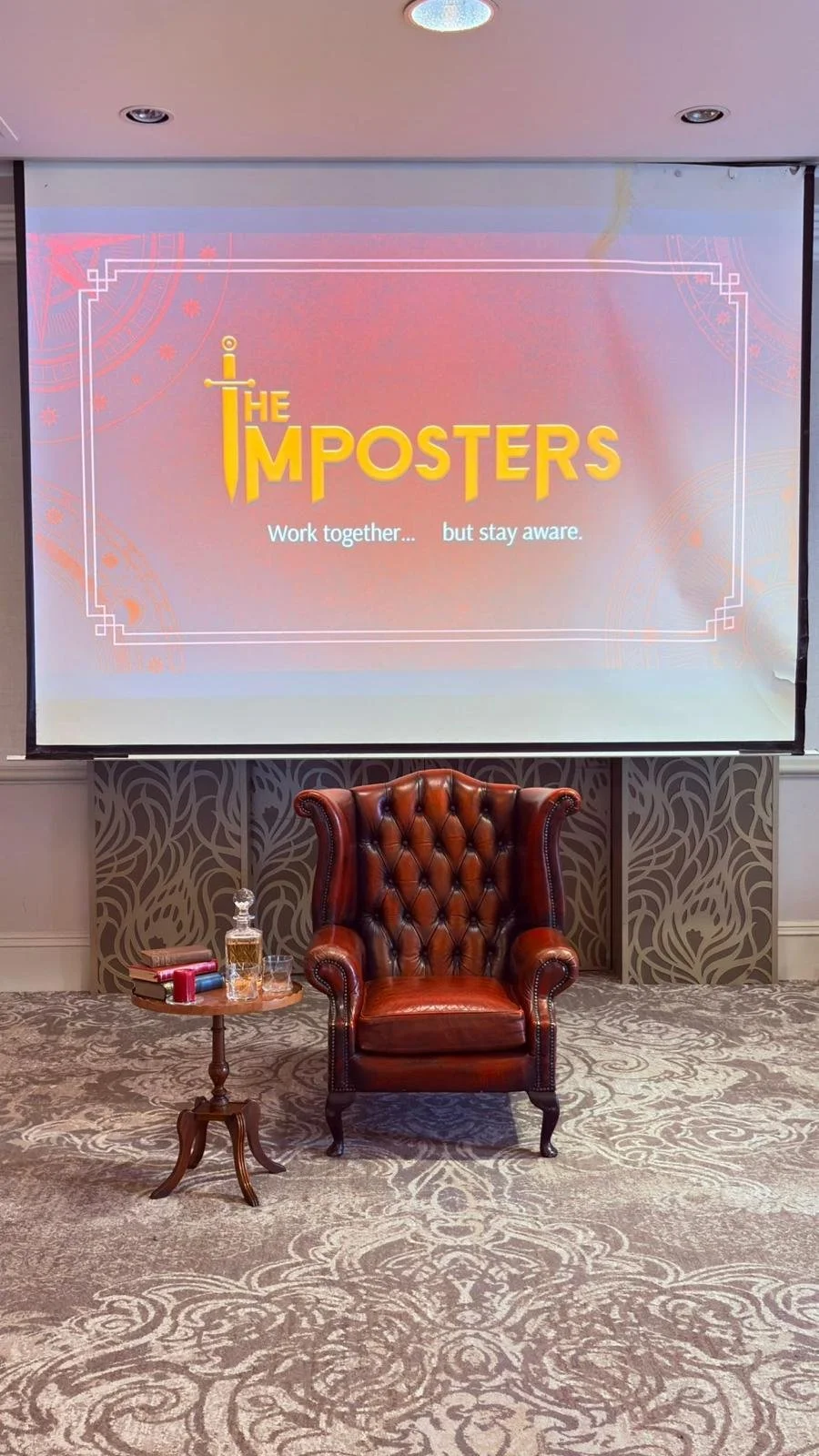
A team building experience built around deception, deduction and competition
The Imposters is a team-based game show experience centred on deception, deduction and competition.
Delivered through a mobile or tablet interface, the activity combines interactive challenges, strategic gameplay and real-time decision-making. It can be delivered in on-site, off-site or hybrid environments, making it suitable for a wide range of organisations and event formats.
The format is fast-paced and highly engaging. Teams work through a series of interactive rounds designed to test observation, communication, logic and strategic thinking. Within each round, players must complete tasks while trying to identify who among them may be acting as an imposter.
Success depends on how effectively participants analyse behaviour, question assumptions, share information and collaborate to uncover the truth. At the same time, those playing the role of imposter must remain undetected, using strategy, confidence and misdirection to influence the outcome.
This creates a dynamic team environment where people are constantly observing, interpreting, discussing and deciding.
The result is a high-energy experience that feels fun and competitive, while also placing real team behaviours under the spotlight.
Why The Imposters works as a team building activity
Many workplace challenges are not caused by lack of effort. They are caused by incomplete information, unclear communication, weak trust or assumptions that go untested.
Teams often have to make decisions without having every fact available. They have to assess what is credible, decide who to listen to, manage competing views and move forward with confidence. These are everyday business challenges.
The Imposters recreates these pressures in a safe, engaging and memorable way.
Participants must communicate clearly, listen carefully and make sense of the information available to them. They have to decide when to challenge, when to support, when to question and when to act. They must balance individual judgement with group decision-making.
Patterns quickly emerge.
Who shares information clearly?
Who spots inconsistencies?
Who challenges assumptions?
Who influences the group?
Who hangs back?
Who helps the team reach a decision?
Who becomes distracted by the wrong evidence?
These behaviours matter because they often mirror how teams operate at work.
In a business environment, the same patterns can influence meetings, project delivery, leadership conversations, customer service, change programmes and cross-functional collaboration. The Imposters gives teams a practical reference point for discussing these behaviours without blame or formality.
The activity is the vehicle.
The outcome is greater awareness of how trust, communication and decision-making shape performance.
Trust under uncertainty
Trust is one of the most important foundations of any effective team. Without trust, communication becomes guarded, decisions take longer and collaboration becomes harder.
However, trust is not simply about liking each other or getting along. In performance terms, trust is about confidence in the way people behave, contribute and follow through. It is about whether team members believe that information is being shared honestly, that colleagues are acting with purpose and that the group is working towards a shared outcome.
The Imposters places trust under pressure.
Participants cannot simply accept everything at face value. They have to observe, interpret and test what they are hearing. They must work out where confidence is justified and where further questioning is needed.
This creates a powerful parallel with workplace life.
In many organisations, teams are working through ambiguity. They may be dealing with change, restructuring, growth, new technology, resource pressure or shifting priorities. In these situations, trust becomes essential. Teams need to know how to share information, challenge constructively and make decisions without becoming paralysed by uncertainty.
The Imposters helps teams experience this in real time.
It shows how trust is built, tested and sometimes misplaced. It also highlights the importance of communication habits that allow teams to remain open, thoughtful and effective even when the situation is unclear.
Communication that creates clarity
When teams are under pressure, communication can quickly become reactive.
People may speak more, but say less. Information may be shared, but not interpreted. Assumptions may be made, but not tested. Decisions may be reached, but not fully understood.
The Imposters requires a different standard of communication.
Teams have to explain what they have seen, what they think it means and why it matters. They need to listen to each other, compare evidence and build a shared picture. The quality of communication directly affects the quality of the decision.
This is where the activity becomes relevant beyond the event itself.
In the workplace, clarity is rarely created by volume of communication alone. It is created by purposeful communication. People need to know what is important, what is uncertain, what has changed and what needs to happen next.
The Imposters reinforces this by making communication visible. Teams see the difference between noise and useful information. They experience how quickly confusion can spread when assumptions are not challenged. They also see how much more effective they become when people communicate with focus and intent.
For organisations facing uncertainty, this is particularly valuable.
Clear communication helps teams remain aligned. It reduces duplication, prevents misunderstanding and supports better decision-making. It also helps people feel more connected and confident when pressure increases.
Better decision-making through shared judgement
Decision-making is one of the clearest indicators of team effectiveness.
A team may be energetic, committed and busy, but if it struggles to make good decisions, performance will suffer. Decisions may be delayed. Responsibility may be unclear. Strong voices may dominate. Useful insight may be missed. Teams may act too quickly, too slowly or without enough alignment.
The Imposters creates a controlled environment where decision-making is tested repeatedly.
Teams must assess evidence, debate possibilities and reach conclusions. They must decide who to trust, what to prioritise and when to act. They must do all of this while managing competition, time pressure and uncertainty.
This makes the experience highly relevant for organisations that want to improve how their teams perform.
Effective decision-making requires more than individual intelligence. It requires collective discipline. Teams need to know how to gather information, challenge thinking, manage disagreement and commit to action. They need to avoid groupthink, overconfidence and hesitation.
The Imposters brings these issues to life.
It gives teams a memorable example of how decisions are made under pressure and what can improve or weaken the process. This creates useful insight that can be carried back into the workplace.
From competition to collaboration
Although The Imposters is competitive, it is also deeply collaborative.
Participants need to work together to succeed. They must combine observations, share perspectives and build a collective view of what is happening. No single person has all the answers.
This is important because collaboration is not simply about being cooperative. It is about using the combined capability of the team to achieve a stronger outcome than individuals could achieve alone.
In many organisations, collaboration is assumed but not always practised effectively. Teams may work in parallel rather than together. Information may sit in silos. People may protect their own area rather than contribute to the whole. Under pressure, these behaviours can become more pronounced.
The Imposters challenges that pattern.
It encourages people to pool insight, listen across the group and recognise the value of different thinking styles. Some participants may be strong observers. Others may be logical analysts. Some may notice behavioural cues. Others may be persuasive communicators. The best teams learn how to use those differences.
That is a key lesson for the workplace.
High-performing teams do not require everyone to think the same way. They require people to understand how different strengths contribute to shared outcomes.
A purposeful experience, professionally delivered
The Imposters is designed to be simple to participate in and professionally managed from start to finish.
BlueSky Experiences works with organisations to understand objectives, group dynamics and the type of experience required. On the day, the activity is designed to feel engaging, inclusive and easy to take part in, allowing people to relax, get involved and enjoy the experience.
Behind the scenes, experienced facilitators and event teams manage the flow, maintain momentum and keep energy levels high. Real-time scoring and leaderboard tracking add competition and pace, while the shared digital platform makes participation accessible through mobile or tablet devices.
The experience is suitable for groups of different sizes and can work across in-person, remote or hybrid environments. It can be used as part of a conference, away day, evening event, team building programme or wider development activity.
What matters most is that the event feels natural, enjoyable and memorable while still creating meaningful opportunities for teams to connect and reflect.
The link to high-performing teams
At BlueSky Experiences, The Imposters sits within a broader view of team performance.
Our High-Performing Team Model focuses on six drivers:
Culture
Captaincy
Communication
Clarity
Collaboration
Connectedness
The Imposters touches each of these areas.
It reveals aspects of culture by showing how people behave when pressure, uncertainty and competition are introduced.
It highlights captaincy by showing how influence, leadership and direction emerge within the group.
It tests communication by requiring participants to share useful information clearly and quickly.
It builds clarity by encouraging teams to separate evidence from assumption.
It strengthens collaboration by making success dependent on shared insight.
It develops connectedness by creating a memorable experience that brings people together through shared challenge.
This is why the activity can be much more than a fun event. It can become a practical demonstration of the behaviours that support stronger team performance.
Why this matters now
The modern workplace is full of ambiguity.
Teams are asked to respond to change, absorb new information, adapt to shifting priorities and maintain performance under pressure. Leaders are expected to create confidence when not everything is certain. People are expected to collaborate across functions, locations and working patterns.
In this environment, the ability to communicate clearly, build trust and make good decisions is critical.
The Imposters provides a powerful way to explore these behaviours through shared experience. It gives teams the opportunity to step away from daily routines and see how they operate in a different context.
That insight can then support better conversations back at work.
How do we make decisions?
How do we challenge assumptions?
How do we share information?
How do we build trust?
How do we respond when the picture is unclear?
How do we use different strengths across the team?
These are not abstract questions. They are central to performance.
A practical opportunity for your organisation
If your organisation is looking for a team building experience that is high-energy, inclusive and purposeful, The Imposters offers a distinctive option.
It is ideal for teams that want to improve communication, strengthen trust, encourage collaboration and explore decision-making under pressure. It works well for organisations facing change, growth, uncertainty or the need to reconnect people across teams and locations.
The experience is engaging and competitive, but the value goes beyond the game itself.
The Imposters helps teams see how they perform when trust, strategy and communication are tested. It creates shared energy, shared insight and a practical reference point for better teamwork.
In an increasingly uncertain world, teams need more than activity.
They need connection, clarity and confidence.
BlueSky Experiences helps organisations bring people together with purpose.
Talk to BlueSky Experiences about The Imposters and discover how your teams perform when trust, strategy and competition collide.