
Real People. Real Connection. Better Outcomes.
Why human connection matters in an increasingly impersonal world
Organisations are operating in a world that often feels more digital, more distant and more impersonal.
Technology is reshaping how work is organised. Artificial intelligence is accelerating the pace of change. Hybrid working has altered the rhythm of team life. Economic pressure is sharpening the focus on productivity, cost and measurable return. Political and social uncertainty continues to influence how people feel, how they behave and how they respond to change.
Against this backdrop, it is easy for organisations to focus almost entirely on systems, platforms, processes and efficiency. These things matter. They help organisations scale, organise and respond. But they do not replace the human foundations of performance.
Behind every strategy, every transformation programme, every customer experience and every operational target, there are still people.
People who need to communicate clearly.
People who need to trust each other.
People who need to work together under pressure.
People who need to feel connected to purpose, colleagues and outcomes.
This is why human connection is not a soft issue. It is a performance issue.
At BlueSky Experiences, our ethos is clear: we aim to be your People Partner of Choice.
That means helping organisations bring real people together through purposeful Team Building, Team Development, Insights Discovery, Leadership Development and High-Performance Pathway activity. In an increasingly impersonal world, we believe the organisations that invest in connection, trust, communication and shared experience will be better placed to perform.

The growing risk of disconnection
The need for human connection is not limited to the workplace. It is part of a wider social and economic challenge.
In May 2026, the UK Government published the Young People and Work Interim Report, an independent review into the rising number of young people who are not in education, employment or training. The report described Britain as facing a “generational fault line” and warned that the issue is no longer simply about temporary youth unemployment, but about deeper detachment from the labour market. It stated that nearly 60% of young people who are NEET are economically inactive, meaning they are not just out of work, but not actively looking for work.
The Office for National Statistics also reported that in January to March 2026, an estimated 13.5% of all young people aged 16 to 24 in the UK were not in education, employment or training. This represented an increase both over the year and over the previous quarter. The ONS also estimated that 613,000 young people aged 16 to 24 were economically inactive and NEET during the same period, although it advises caution when interpreting short-term Labour Force Survey movements.
These figures matter because they point to something deeper than employment status alone. They suggest a risk of growing disconnection: from work, from opportunity, from purpose and from participation.
This is why the phrase “lost generation” has entered the public conversation. The concern is not simply that young people may be out of work today. The concern is that prolonged detachment can affect confidence, skills, aspirations, wellbeing and future contribution.
For employers, this has immediate relevance. Organisations cannot solve every social and economic challenge, but they do shape the environments in which people work, learn, contribute and grow. They influence whether people feel seen, supported and included. They determine whether teams are places of connection or isolation.
In that context, bringing people together with purpose becomes more important, not less.
The workplace still depends on people
In an automated and increasingly digital environment, it can be tempting to believe that better systems alone will create better performance.
They will not.
A new platform may improve access to information, but it does not automatically create trust. A process may clarify workflow, but it does not guarantee ownership. A strategy may set direction, but it does not mean people understand how to work together to deliver it.
Performance depends on the way people behave together.
Do they communicate clearly?
Do they understand priorities?
Do they trust each other?
Do they collaborate across functions?
Do they support each other under pressure?
Do leaders create clarity and confidence?
Do teams feel connected to the purpose of the organisation?
These are human questions. They are also commercial questions.
When teams lack connection, the symptoms are familiar. Meetings increase, but decisions slow down. Activity rises, but impact does not. People work hard, but not always in alignment. Communication becomes reactive. Priorities blur. Energy is spent managing friction rather than delivering outcomes.
This is the distinction BlueSky Experiences often makes between performance and effectiveness.
Performance is visible. It is output, effort, action and delivery. Effectiveness is deeper. It asks whether that effort has created meaningful progress. Did the work improve outcomes? Did it strengthen capability? Did it help the team operate better next time?
In an uncertain world, organisations need both. They need teams that can deliver, but they also need teams that can learn, adapt and improve.
That requires human connection.
Why real shared experience matters
Real shared experience creates something that cannot be fully replicated through emails, dashboards or virtual updates.
It gives people the opportunity to interact differently. It takes them out of familiar routines. It allows behaviours to become visible. It gives teams a chance to see how they communicate, how they plan, how they respond to pressure and how they support each other.
This is why Team Building and Team Development still matter.
Used poorly, team building can be dismissed as entertainment. Used well, it becomes a practical way to strengthen how people work together.
At BlueSky Experiences, the activity is never the whole point. The activity is the vehicle.
A Highland Games event, an indoor challenge, an outdoor problem-solving activity, a Team Energy session, Hunger Battles, It’s a Knockout, Insights Discovery or a structured development workshop may all look different on the surface. But each can create the same opportunity: to bring people together in a purposeful way and help them understand something useful about how they operate as a team.
Some teams need to reconnect after a period of change.
Some need to rebuild trust.
Some need to communicate more clearly.
Some need to develop confidence.
Some need to understand each other’s strengths.
Some need to align around shared priorities.
Some need to create energy and momentum.
The right intervention depends on the need. But the principle remains consistent.
Real people need real connection.
From activity to outcomes
The BlueSky Experiences approach is shaped by the High-Performing Team Model, which focuses on six drivers of performance:
Culture
The values, behaviours and expectations that shape how people work together.
Captaincy
The leadership, direction and accountability that help teams move with purpose.
Communication
The quality, clarity and consistency of how people exchange information and meaning.
Clarity
The shared understanding of priorities, roles, goals and expected outcomes.
Collaboration
The ability to work across individuals, teams and functions to solve problems and deliver results.
Connectedness
The relationships, systems and sense of belonging that help people operate as a real team.
These drivers matter because they translate human connection into practical performance improvement.
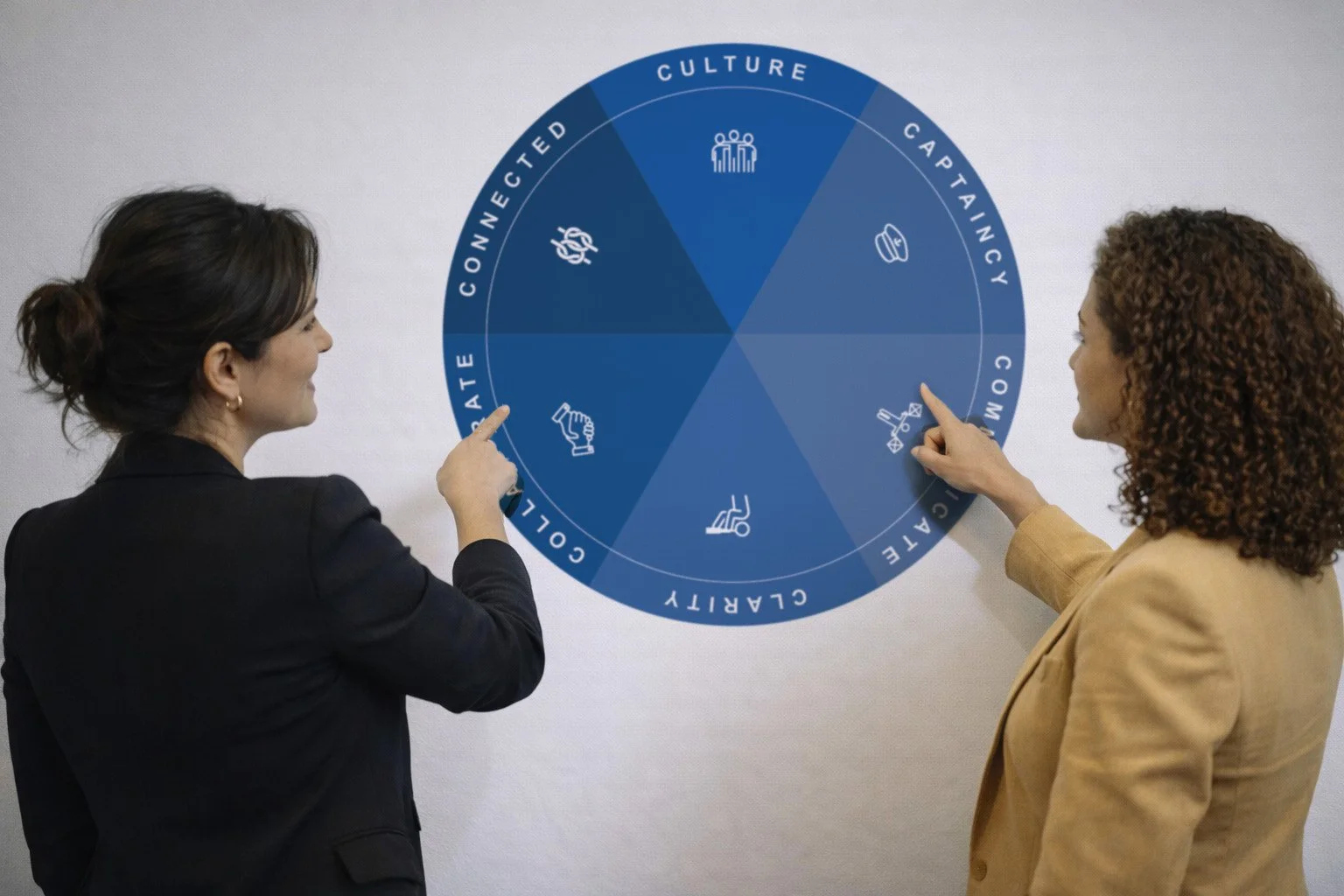
When culture is strong, people know what is expected.
When captaincy is effective, people have direction.
When communication improves, friction reduces.
When clarity exists, effort becomes focused.
When collaboration strengthens, problems are solved more effectively.
When people feel connected, they are more likely to contribute, support each other and stay engaged.
This is why BlueSky Experiences positions Team Building, Team Development and Leadership Development as part of a wider performance pathway, not as isolated activity.
The aim is not simply to create a memorable day. The aim is to help teams operate better when they return to work.
Leadership in an impersonal world
The more impersonal the working environment becomes, the more important leadership becomes.
Leaders are the people who create direction when there is ambiguity. They set tone when pressure rises. They help people understand what matters. They create the conditions for trust, accountability and confidence.
But leadership itself is becoming more demanding.
Many leaders now manage hybrid teams, dispersed teams, multigenerational teams and teams affected by change fatigue. They are expected to deliver performance while supporting wellbeing, inclusion, engagement and resilience. They must communicate clearly when they may not have all the answers themselves.
This is why Leadership Development is an important part of the BlueSky Experiences offer.

Leadership is not just about individual confidence or management technique. It is about the leader’s role in shaping team performance. Leaders influence culture, clarity, communication and accountability. They help people understand how their work connects to wider outcomes.
In an increasingly impersonal world, effective leaders make work feel more human.
They create connection.
They give people context.
They make expectations clear.
They encourage contribution.
They help teams navigate uncertainty.
Leadership Development, therefore, is not separate from Team Development. It is central to it.
A people partner, not simply an events provider
BlueSky Experiences has delivered events and development activity for more than two decades, but the purpose behind the work has evolved with the needs of organisations.
Today, organisations are not simply looking for “an event”. They are looking for ways to improve connection, engagement, communication, leadership and performance.
They want people to work better together.
They want teams to adapt to change.
They want managers to lead with confidence.
They want colleagues to feel part of something meaningful.
They want activity to connect to outcomes.
That is why the “People Partner of Choice” ethos matters.
A people partner does not start with a catalogue of activities. A people partner starts with the organisation’s need.
What is happening in the team?
What pressure is the organisation facing?
Where is communication breaking down?
Where is clarity missing?
What needs to improve?
What outcome does the client need to achieve?
From there, the right response can be designed. That may be a high-energy Team Building experience, an Insights Discovery session, a Team Development programme, a Leadership Development journey or a more structured High-Performance Pathway.
The format can vary. The intent stays the same.
Bring people together with purpose.
Why this matters for employers
The UK’s wider concerns around NEETs, disengagement and labour market detachment may seem distant from day-to-day organisational life, but they should prompt employers to think carefully about the experience they create for people at work.
Work is not only a place of economic contribution. It is also a place where people build confidence, identity, relationships, skills and purpose.
When workplaces become too transactional, people can disengage. When communication becomes too impersonal, trust can weaken. When teams lose connection, performance suffers. When people do not feel involved or valued, retention becomes harder.
This matters for established employees as much as it matters for young people entering the workforce.
Organisations that want to attract, retain and develop talent need to create environments where people can participate, contribute and grow. That does not happen by accident. It requires deliberate investment in teams, leaders and culture.
Team Building and Team Development are part of that investment.
They create moments where people can reconnect. They build shared language. They reveal behaviours. They strengthen trust. They help people understand each other. They support leaders in creating more effective teams.
In a world where many people are experiencing more distance, more noise and more uncertainty, these moments of real connection carry greater value.
Practical questions for organisations
If your organisation is facing uncertainty, change, growth or disengagement, it may be useful to ask:
Are people aligned around shared priorities?
Do teams communicate clearly, or are assumptions creating friction?
Are colleagues connected across departments, locations or functions?
Do people understand each other’s strengths and working styles?
Are managers confident in leading through uncertainty?
Are teams simply completing tasks, or are they growing in capability?
Do people feel involved, valued and able to contribute?
Is your organisation creating enough opportunity for real human connection?
These questions matter because they sit at the heart of performance and effectiveness.
A team can be busy without being aligned.
A leader can be active without creating clarity.
An organisation can invest in systems without strengthening culture.
People can attend meetings all day and still feel disconnected.
The opportunity is to be more deliberate.
Real connection is a strategic advantage
The world of work will continue to change. Technology will continue to evolve. Economic and social pressure will remain. Organisations will need to keep adapting.
But the human fundamentals of performance will not disappear.
People still need connection.
Teams still need trust.
Leaders still need clarity.
Organisations still need collaboration.
Performance still depends on how people work together.
In an increasingly impersonal world, real human connection is becoming a strategic advantage.
BlueSky Experiences helps organisations create that connection through purposeful Team Building, Team Development, Insights Discovery, Leadership Development and High-Performance Pathway activity.
We bring people together not simply to take part in an event, but to strengthen how they communicate, collaborate and perform.
That is what it means to be your People Partner of Choice.
Talk to BlueSky Experiences about bringing your people together with purpose.