
Performance vs Effectiveness: Why High-Performing Teams Still Underperform
There is a familiar boardroom tension.
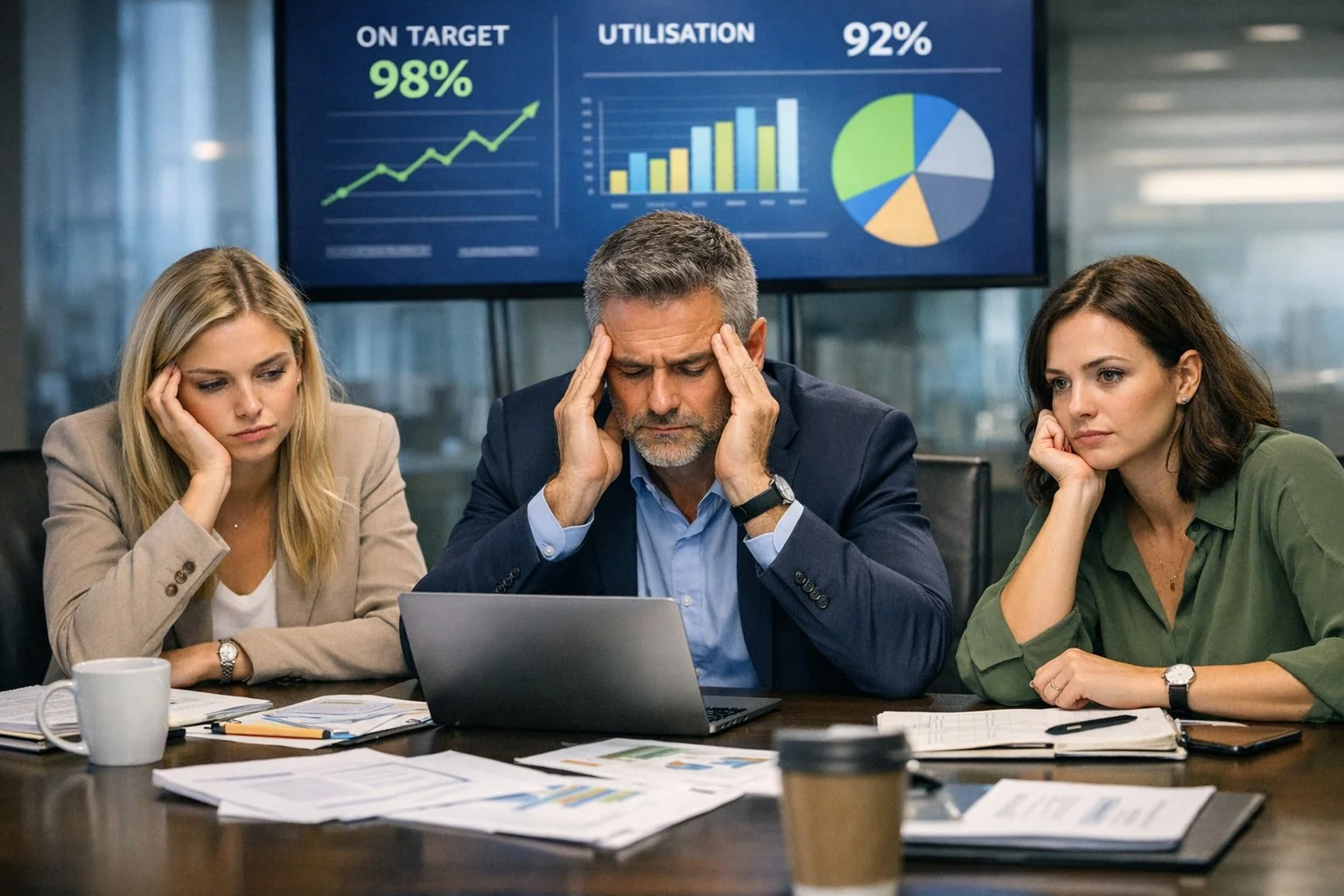
The dashboards look strong, delivery targets are being hit, utilisation rates are high, people are busy, yet something is off.
Client feedback is lukewarm, energy levels are fragile, leaders feel stretched. The same problems resurface every quarter. The team is performing.
But it isn’t fully effective.
Understanding the difference between performance vs effectiveness is one of the most important distinctions senior leaders can make when building truly high-performing teams.
Performance vs Effectiveness: What’s the Difference?
Although often used interchangeably, performance and effectiveness are not the same.
Performance
Performance is primarily an internal measure.
It focuses on:
Output
Efficiency
Productivity
Execution discipline
Resource utilisation
Delivery against targets
Performance answers the question:
Are we doing the work well?
High performance is necessary. Without it, nothing moves. But performance alone does not guarantee strategic success.
Effectiveness
Effectiveness integrates both internal and external impact.
It considers:
Whether output meets or exceeds client needs
Whether the team’s capability is growing sustainably
Whether individuals are developing rather than burning out
Whether the work contributes to long-term organisational performance
Effectiveness answers the question:
Are we doing the right work, in the right way, with sustainable impact?
Performance is about execution.
Effectiveness is about outcome, growth and resilience.
High-performing teams can still underperform strategically if effectiveness is neglected.

Why High-Performing Teams Still Fall Short
Many organisations optimise for internal metrics.
They measure:
Activity
Utilisation
Delivery speed
Cost control
Throughput
These are important. But they can create blind spots.
1. Internal Optimisation Without External Alignment
A team may hit every internal milestone yet fail to meet evolving client expectations. The output is technically strong, but strategically misaligned.
Performance is high.
Business effectiveness is low.
2. Productivity Masking Cultural Fragility
High output can conceal:
Poor collaboration
Leadership ambiguity
Silenced dissent
Fragile morale
When pressure increases, these weaknesses surface.
3. Short-Term Delivery Over Long-Term Capability
Teams focused only on immediate execution often neglect capability growth. They solve today’s problem but do not build the competence to solve tomorrow’s faster or better.
Sustainable performance requires continuous capability expansion.
4. Burnout Disguised as Commitment
Relentless productivity can look like dedication. In reality, it may be slow erosion.
If individuals are not learning, growing and developing through their involvement, long-term organisational performance suffers.
The Three Criteria of Team Effectiveness
To move beyond performance alone, BlueSky evaluates effectiveness against three criteria.
1️⃣ Does the Team Meet or Exceed Client Needs?
The client — internal or external — ultimately defines success.
Effectiveness requires:
Clear stakeholder alignment
Understanding shifting expectations
Feedback integration
Measurable impact
Without external validation, performance remains self-referential.
2️⃣ Is Capability Growing Sustainably?
An effective team:
Solves problems it could not solve previously
Handles familiar challenges faster
Develops strategic judgement
Improves decision quality
Capability growth must be sustainable. Improvement without burnout is essential.
3️⃣ Are Individuals Growing — Not Diminishing?
High-performing teams should enhance the people within them.
Ask:
Are individuals learning?
Are leadership behaviours maturing?
Is engagement increasing?
Are people leaving stronger than they arrived?
Effectiveness requires mutual growth.
Internal vs External Focus: A Structural Distinction
Understanding the internal vs external focus clarifies the performance vs effectiveness divide.
Internal Focus (Performance)
Integrated Focus (Effectiveness)
Output metrics
Client impact
Efficiency
Strategic alignment
Resource utilisation
Stakeholder value
Execution
Sustainable capability
Productivity
Cultural health
Performance optimises inside the system.
Effectiveness ensures the system delivers meaningful impact beyond itself.
Many executive teams default to internal focus because internal metrics are measurable and controllable. External impact requires alignment, clarity and disciplined reflection.
The Foundations of Sustainable High Performance
BlueSky’s experience working with senior teams across complex organisations shows that effectiveness rests on six mutually reinforcing focus areas.
Foundations
Clarity – Shared understanding of priorities and direction
Collaboration – Effective cross-functional working
Connection – Strong internal relationships and stakeholder engagement
Buttresses
Culture – Behavioural norms that sustain performance
Captaincy – Leadership maturity and accountability
Communication – Quality of dialogue and situational awareness
When these elements are aligned, performance and effectiveness converge.
Without them, performance becomes fragile.
Why Leadership Development Is Central
Leadership development is not an adjunct to team development. It is integral to improving team performance sustainably.
Leaders shape:
Decision quality
Cultural tone
Accountability norms
Strategic alignment
Energy management
Without leadership clarity, performance initiatives drift into tactical optimisation rather than systemic improvement.
Executive team performance depends on leaders who can balance execution discipline with external awareness.
From Activity to Impact: The High-Performance Pathway
BlueSky’s High-Performance Pathway integrates performance and effectiveness into a structured system.
It begins with:
Analysing context
Establishing alignment
Diagnosing team effectiveness
Clarifying start state foundations
It progresses through:
Collaborative planning
Stakeholder engagement
Capability development
Leadership strengthening
And it reinforces through:
Targeted interventions
Incremental performance improvement
Sustainable effectiveness metrics
The objective is not a temporary uplift in output.
It is a sustained increase in organisational performance grounded in strategic alignment and cultural strength.
Executive Reflection Questions
Senior leaders may wish to consider:
Are we measuring performance or true effectiveness?
Do our clients define success the same way we do?
Is our capability expanding — or merely stretching?
Are individuals growing through participation?
Is collaboration robust under pressure?
Are we optimising internal efficiency at the expense of external impact?
Would our team be stronger next year without additional external pressure?
These questions move teams from activity to strategic effectiveness.

When Performance and Effectiveness Align
The most resilient organisations demonstrate:
High output
Clear external alignment
Growing capability
Strong leadership maturity
Sustainable energy
Cultural coherence
Performance fuels delivery.
Effectiveness ensures that delivery matters.
In competitive markets, sustainable performance becomes a differentiator.
Final Thought
High-performing teams are valuable.
Effective teams are strategic assets.
The distinction between performance and effectiveness is not academic. It is operational, cultural and commercial.
For organisations seeking to improve team performance, strengthen leadership development and build sustainable competitive advantage, the question is not:
How do we work harder?
It is:
How do we become more effective?
BlueSky’s High-Performance Pathway exists to answer that question — systematically and sustainably.